The first time I came across Clairtone’s Project G stereo (1964) was in 2019, as an undergrad summer intern assigned to the Canadian Collection at the Royal Ontario Museum (ROM). For those few months, my days revolved around cataloguing an acquisition of artefacts from the former Design Exchange (DX) collection. Among them was the Project G. I was first struck by its size: together its Brazilian Rosewood cabinet, which housed the amplifier and turntable, and spherical black metal speakers measured over two meters in length. While I could easily imagine much of the furniture included in that acquisition in a future apartment of mine, the Project G definitely felt like it belonged to another era— designed for spacious rooms where people who could be described as suave milled around.
Fast-forward to 2024, when I joined the xDX Project as a graduate research assistant — working to reconnect the collection I had catalogued for the ROM with the rest of the former DX artefacts and archival records. Given this turn of events, I chose to revisit the Project G as part of my coursework. This work took me back to the ROM archive, which is now the home of the former DX Clairtone fonds. Books and catalogues featuring articles on the Project G written by xDX collaborators Rachel Gotlieb and Alan Elder, also proved invaluable for my research.1
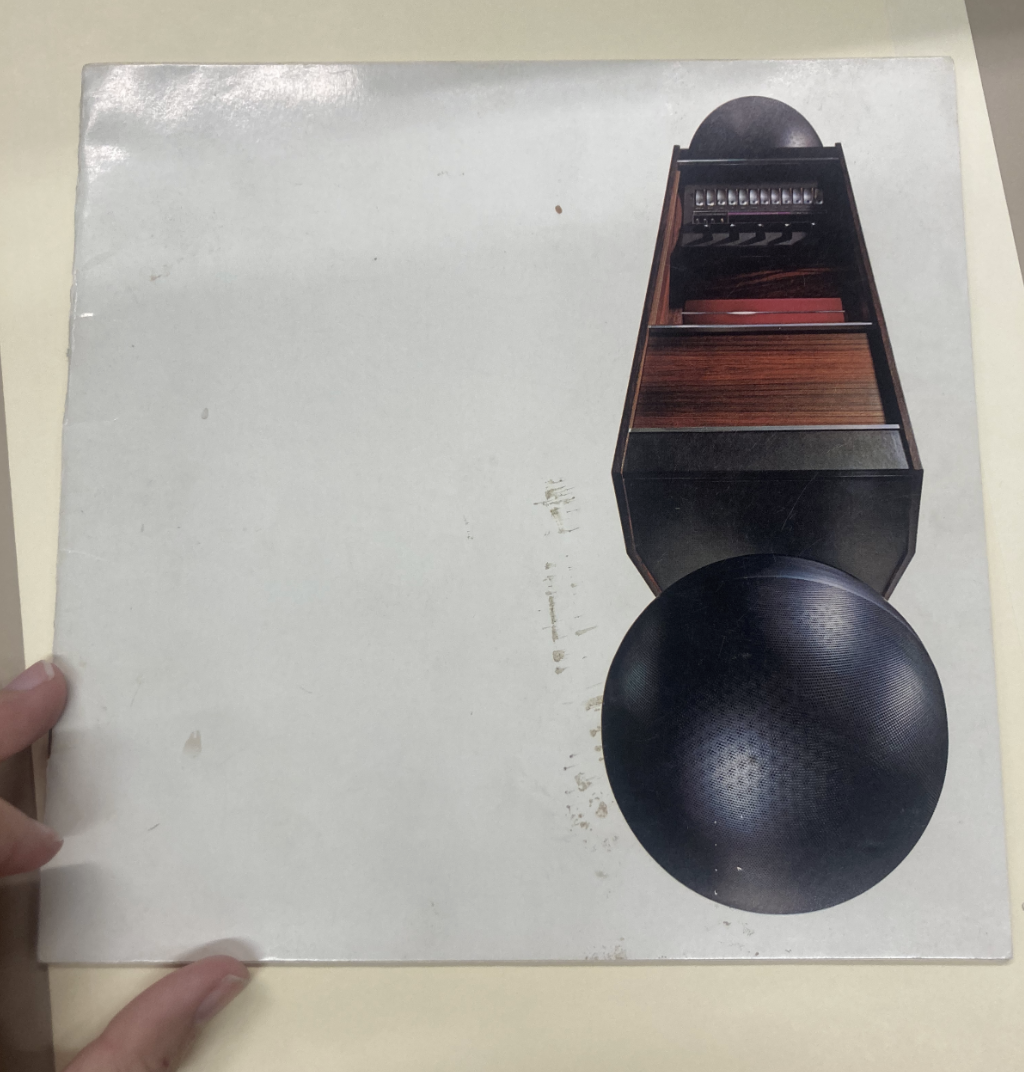
In the end, my initial impression of the Project G in 2019 was not so far off: the Project G was the “concept car” of the Clairtone line. Company co-founders Peter Munk and David Gilmour gave the industrial designer Hugh Spencer a brief instructing him to design something “way out” for the following year.2 Thus, the spectacular Project G came to be— a luxury, aspirational flagship product of a line of more accessibly priced and styled Clairtone stereos. The Project G won silver in the 1964 Milan Triennial of design. ROM’s Clairtone fonds is rich with material from Project G’s initial advertising and merchandizing campaigns, including a Project G brochure featuring images by fashion photographer Irving Penn. The imagery and graphic design of the brochure felt strikingly contemporary to me, its pages would not be out of place in the mood boards of art directors working today. The brochure’s cover, featuring what advertisers call a “hero shot” of the Project G by Penn anticipates how companies like Apple depict their products today.
When our xDX Infrastructure Partners, LINCS, delivered the beta version of the xDX’s ResearchSpace, the Project G and Clairtone’s G series stereos were the perfect use-case to test the capabilities of our transformed dataset because they encompassed many of the facets that make xDX ResearchSpace unique. First, LINCS worked to ensure that different artefacts that are examples of the same model would be linked in our dataset, as well as any artefacts part of the same branded series.3 Among the xDX Clairtone artefacts there are instances of both series and models as four Clairtone artefacts are related to the “G series” with two being instances of the same “G3” model. We also worked with LINCS to develop a facet for our data model that would connect the dispersed DX artefacts with relevant DX archival files, also now held by several of our partner institutions, by tagging the archival files with related model and series identifiers.4 In the case of the Clairtone artefacts, the xDX team went through ROM’s Clairtone Finding Aid to tag all the relevant archival files with their respective Clairtone model and series IDs. By connecting our artefact and archival collections through the concepts of series and models, the xDX Project created a truly bespoke research resource for design historians.
I explored the connections between the G series artefacts and archives in ResearchSpace through the KnowledgeMap function. As discussed in our February 2026 blog post, KnowledgeMaps: “harness the power of Linked Open Data to visualize the connections between people, objects, groups, materials, and places within the xDX dataset.” In this tool, found an affinity with a networked approach to research. For one KnowledgeMap, I traced the different actors associated with the Project G in xDX archival and object records. This Map allowed me to visualize who was connected to building the historiography of this particular object, and through what means. It was an amazing way to begin the research process, and I ended up presenting the fruits of this research in Fall 2025 at the Society for the History of Technology conference in Luxembourg in a session on the xDX Project alongside Prof Jan Hadlaw, the xDX Project’s Principal Investigator and Aviva Weizman, the project’s PhD Research Assistant.
Working on the xDX Project has been a full-circle moment for me. I was able to return to work I had done years earlier and to build on it. Helping to create an open-source research tool that reconnects the deaccessioned and dispersed DX artefacts—including those that I catalogued at the ROM back in 2019—has been a privilege. I feel I have contributed to making it easier to research the history of Canadian design. And while I still cannot imagine any future apartment of mine being home to the Project G, I could see a Clairtone G3 (1966) possibly fitting in somewhere….
Rosalind Sweeney-McCabe, MA RA York University
Footnotes
1.) Rachel Gotlieb and Alan C. Elder are Canadian design historians and curators. Their work on Clairtone informed several curatorial projects: Gotlieb for the exhibition and subsequent publication, The Art of Clairtone: The Making of a Design Icon 1958-1971 (2008) held at the DX; and Elder as curator of Decorative Arts and Design at the Canadian Museum of History for the exhibition, Cool ’60s Design/Design à gogo (2004), and subsequent publication Made in Canada: Craft and Design in the Sixties (2005).
2.) Nina Munk and Rachel Gotlieb, The Art of Clairtone: The Making of a Design Icon, 1958-1971 (McClelland & Stewart, 2008), 27.
3.) A discussion of the creation of this facet can be found in our February 2025 blogpost.
4.) We discussed the thought process behind this aspect of our model in the April 2025 blogpost.

