We are pleased to announce that the xDX ResearchSpace is now live and accessible to the public! The xDX ResearchSpace, hosted by our partners at LINCS, is the result of countless hours of learning, collaboration, and iteration conducted by the xDX Project team over the last two and a half years. The publication of this bespoke tool does not mean that the xDX Project is complete. Instead, it signifies a pivot to the final phase of the project: experimenting with the technical affordances and research potentials of the xDX ResearchSpace interface.
Much like the prototypes in the xDX Collection that were the subject of our January blog by Prof Hallgrimsson, the current iteration of the xDX ResearchSpace can also be productively understood as a prototype. While it does not “materialize knowledge” in the same way a three-dimensional prototype would, it does function similarly to Hallgrimsson’s epistemic object: “a thing to think with.” This iteration of the xDX ResearchSpace includes data from the previously disconnected xDX Project partner datasets, transforming it into a linked and accessible interface, which allows us to think with and through our data, to identify areas needing attention, to optimize connections, and to explore research questions now and for the future.
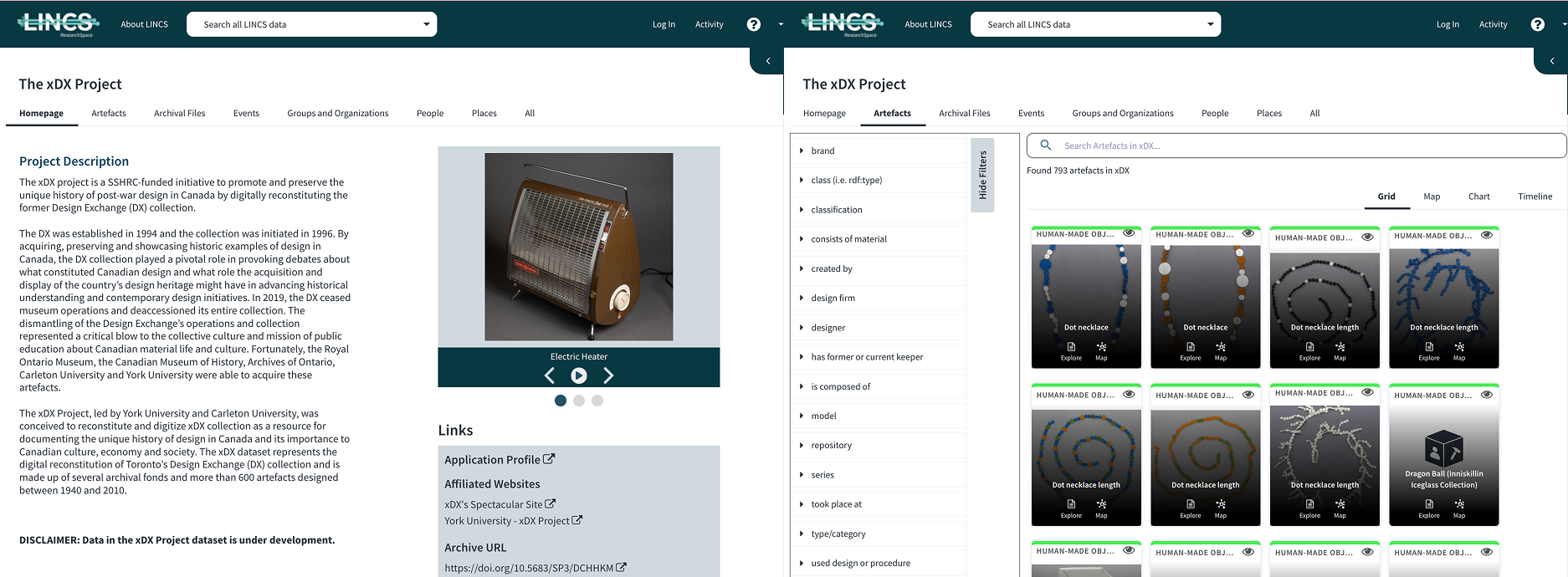
Image 2 (Right): A snapshot of xDX objects, displaying ResearchSpace’s filtering functionalities.
During Winter 2026, the xDX RA team will be joined by students in Prof. Hadlaw’s DESN 4103: Histories of Designed Things course in thinking with xDX ResearchSpace’s Knowledge Maps and Semantic Narratives to test the connective potential of the interface, to audit data anomalies, and to conduct research using a networked approach. Our combined efforts will inform the next and final iteration of the xDX Research Space.
Knowledge Maps, one of the affordances of ResearchSpace, harness the power of Linked Open Data1 to visualize the connections between people, objects, groups, materials, and places within the xDX dataset2. This is a valuable tool as it transcends the conventional, flat structures of database summary pages, allowing researchers to map connections and visualize possible networks within the dataset as they explore the xDX Collection. Semantic Narratives, on the other hand, provide a space to verbally contextualize interactive diagrams created in ResearchSpace, resisting the stasis of graphs and charts in print.3

Our initial experimentation with Knowledge Maps in the xDX ResearchSpace has already given rise to potential research directions for our team. Inspired by our work with the physical collection and ongoing digitization activities, Rosalind and I identified the female designers appearing in the xDX Collection data. The image above is a knowledge map showing the 13 entities representing the women who appear “in the role of” designer across the entirety of our artefactual collection. This is a striking contrast to the 136 male designers appearing “in the role of” designer in the xDX collection. Creating a Knowledge Map of the male designers represented in the collection would result in a Map so populous, it would forego legibility. On the practical level, we’re starting to get a real sense of when Knowledge Maps are effective research tools. For our own research interests, xDX Research Space has allowed us to chart an absence of women in legacy xDX data.
While the xDX ResearchSpace includes only the artefacts and records held in the former Design Exchange Collection, the very disproportionate representation of male and female designers in the dataset is suggestive and appears to be consistent with women’s presence in design collections and design scholarship during this same period, lending credence to Cheryl Buckley’s assertion that women’s significance in design, “as practitioners, theorists, consumers, historians, and as objects of representation [have been] consistently ignored”.4
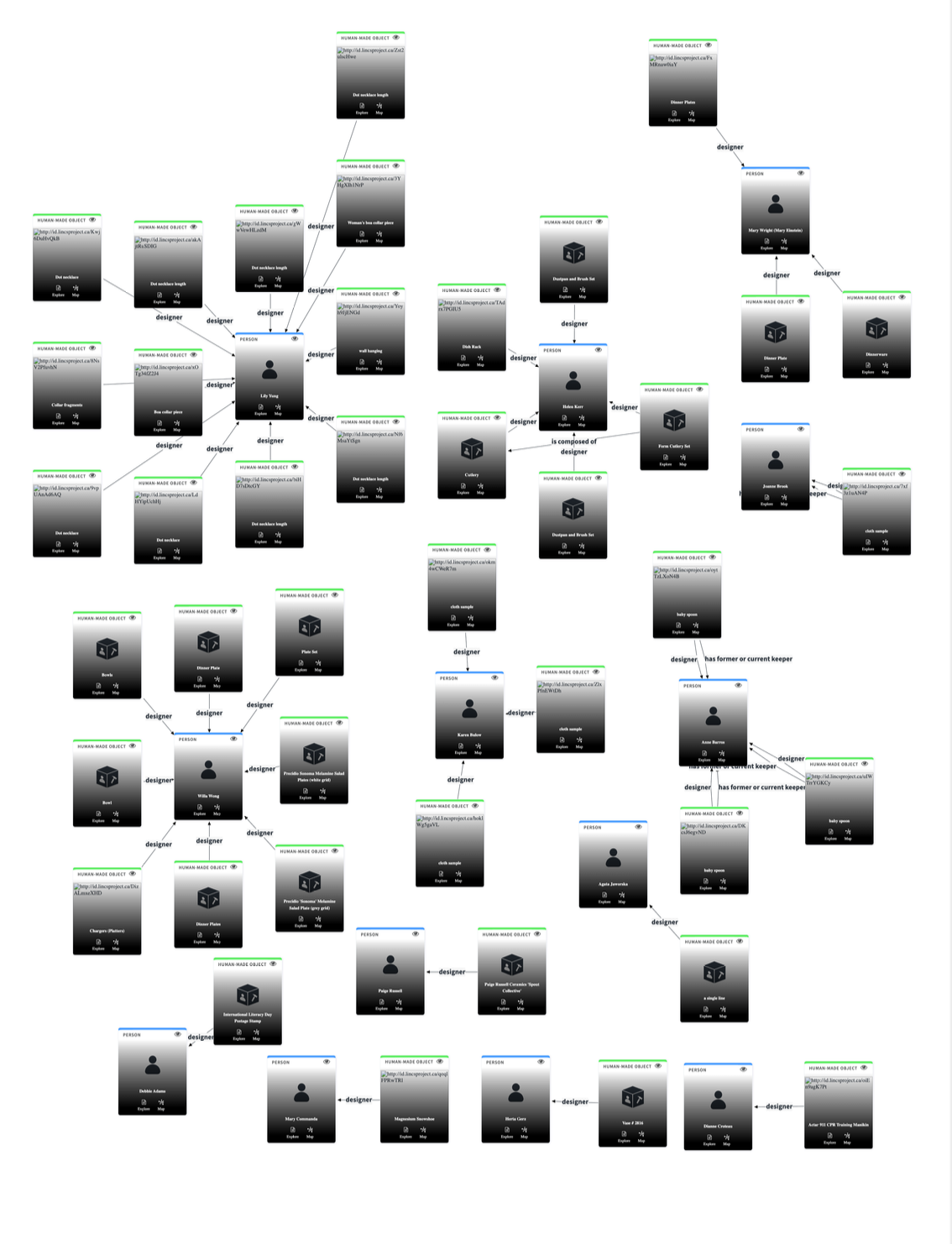
We’re interested in how our own research can intervene in this absence of women in the xDX Collection by investigating instances where women do appear in xDX artefact and archival collections. In the above Knowledge Map, which can be viewed interactively here, we’ve connected each named female designer appearing in the xDX Collection to the artefacts they designed. Over the next month, we will be highlighting the contributions these women have made to the (x)DX Collection and by extension to the history of design in Canada.
We invite you to, likewise, experiment with the current version of the xDX ResearchSpace and welcome your feedback. Please contact us via: https://forms.office.com/r/xvWFK2jcvs
Aviva Weizman, Lead RA, York University
Rosalind Sweeney-McCabe, MA RA, York University
Footnotes
1.) Wood Ruby, L. (2020). Provenance Research in a Digital Age. In A. Tompkins (Ed.), Provenance Research Today: Principles, Practice, Problems, (pp. 97-104). Lund Humphries.
2.) Oldman, D. & Tanase, D. (2018, October 10). Reshaping the Knowledge Graph by Connecting Researchers, Data and Practices in ResearchSpace [Conference presentation]. International Semantic Web Conference. Monterey, California, United States.
3.) British Museum. (2022). Research Space: Semantic Tools.https://researchspace.org/semantic-tools/
4.) Buckley, C. (1986). Made in Patriarchy: Toward a Feminist Analysis of Women and Design. Design Issues, 3(2).

