Prototyping sits at the very heart of product design. It’s where ideas stop being abstract and start pushing back, where assumptions get tested, hands get dirty, and design decisions become real. Physical prototypes are essential tools for uncovering design problems, exploring imaginative solutions, understanding human interaction, and testing functionality in ways that drawings and computer-aided design (CAD) alone simply do not suffice.
Early in my career, I learned that design does not progress in a neat, linear sequence from sketch to CAD to finished product. Instead, it evolves through constant back-and-forth between thinking and making. Very early sketches often demand simple, exploratory prototypes built from low-fidelity materials like paper, foam, or cardboard. These rough models help confirm scale, proportion, and spatial relationships, something that a 2D sketch can only hint at. Once an idea moves into three dimensions, the embodied experience changes entirely, allowing designers (and teams) to evaluate form and function in context. The object thus becomes part of the tangible conversation. As projects develop, these early explorations often branch into what are commonly called “works-like” and “looks-like” prototypes. The former focus on function and performance; the latter on form, colour, and emotional or semantic qualities. Over time, these strands come back together in increasingly refined iterations that begin to resemble the final product in its entirety.
A great example of early prototyping in action is the Luau LED portable lantern, designed by Carleton University graduates Stefane Barbeau and Duane Smith. I featured this project in my book on prototyping because it shows how an elegant, innovative product can grow from very simple looks-like and works-like models. The lantern’s form was first explored in blue foam, while parallel functional prototypes tested weight, balance, and carrying comfort. One of the most interesting ideas was using the lantern itself as the interface. A basic works-like model explored integrating a dimmer into the base, allowing the light to be adjusted simply by twisting it on the ground or in hand.
As Barbeau explains, “we wanted to investigate if we could use the form of the lamp itself as an interface in order to simplify the action.” This approach made the handle’s placement and shape a critical part of the design, showing how physical prototypes can directly shape both form and interaction.i


Images from Bjarki Hallgrimsson, Prototyping and Modelmaking for Product Design, second edition (London: Laurence King Publishing, 2019).
This way of thinking about prototypes is especially relevant when looking at the xDX collection. While the collection offers an important opportunity to document and share Canadian design history through finished products and archival materials, it is worth noting that not everything in the collection represents a final, market-ready product. Many of the artefacts are prototypes, sometimes built by designers themselves and created to explore form, test functionality, or experiment with manufacturing processes. Some may never have made it to production at all. These objects are particularly rich sites for research, given how central prototyping is to the design development process. Much of the academic research on prototypes as tools for thinking and problem-solving has emerged relatively recently. Today, prototypes are understood as epistemic objects, i.e. things designers think with. They help materialize knowledge, reduce risk, and communicate ideas in three dimensions to manufacturers, users, and clients alike. Yet many objects in the xDX collection come from a time when prototyping was largely a behind-the-scenes activity. Design education before the 21st century focused heavily on craft and the craft of making skills, rather than explicitly framing prototyping as a cognitive and epistemic practice.
A search through the xDX collection via ResearchSpace reveals several fascinating examples. Some notable prototypes reference the work of Fred Moffatt for General Electric, including the “upside-down” electric kettle prototypes housed at York University.
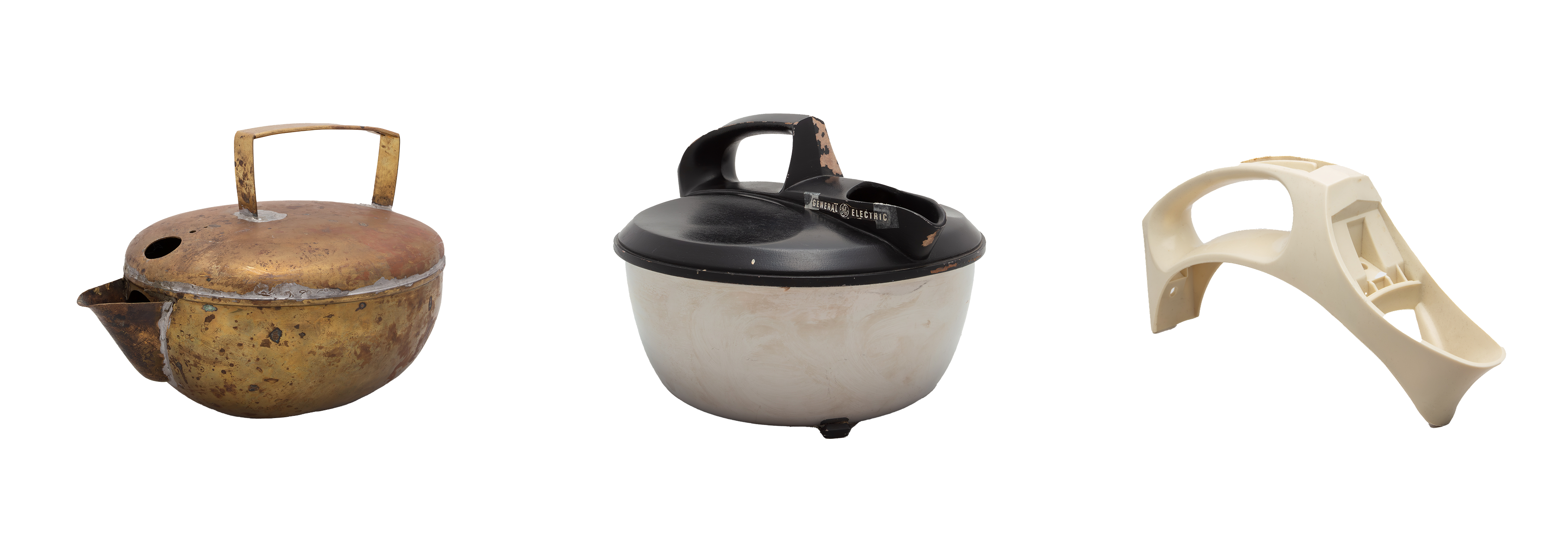
Upside Down Kettle Prototype 1. Fred Moffatt, 1954-55. Item 2022.YU.xDX.00013. Photo: Chris Gergely, Phototechnica © xDX Collection, York University.
Upside Down Kettle Prototype 2. Fred Moffatt, 1954-55. Item 2022.YU.xDX.00012. Photo: Chris Gergely, Phototechnica © xDX Collection, York University.
Kettle (K800) Handle Prototype 3. Fred Moffatt, 1954-55. Item 2022.YU.xDX.00068. Photo: Chris Gergely, Phototechnica © xDX Collection, York University.
The legacy description of the Upside Down Kettle Prototype 1 reads: “Brass coloured kettle shell with lead joining perimeter of top, spout and handle. Rusted over large surface area.” One of the benefits of the work being done by the xDX Project is to catch descriptions that are not technically accurate and contribute additional information and/or elaboration. The description of the kettle as brass coloured is misleading. It is made from a solid copper alloy, such as brass or copper sheet, materials likely chosen for prototyping because they do not rust (contrary to the description) and can be joined using low-temperature welding techniques like brazing. This is a classic “works-like” prototype. It was not intended to represent the final form or materials, but rather to test functional aspects. This would include pouring behaviour and ergonomics of balance. Importantly, the collection also includes evidence of iteration. This speaks to the importance of further research and the insights we gain into the designer’s way of knowing and understanding through prototypes.
A subsequent prototype (Upside-Down Kettle Prototype 2) shows a clear shift toward mass-manufacturable solutions, combining a metal base with an injection-moulded plastic lid. This material choice makes perfect sense: the lid must remain cool to prevent burns. The learning scaffolded from the first prototype is visibly embedded in the second.
Another object listed as a prototype, the Kettle (K800) Handle Prototype 3, reveals yet another iteration towards final product. On closer inspection, tooling marks and material characteristics suggest that, while this artefact is part of the prototyping process, it is not a prototype in the exploratory sense, but rather a production-grade part. It may be better understood as a first-off or pre-production sample, created as part of the manufacturing process rather than the design exploration phase. These conclusions are educated inferences grounded in what design research scholar Nigel Cross refers to as “designerly ways of knowing.”ii
Beyond everyday objects, such as tea kettles, are artefacts that demonstrate Canadian innovation in various industries. This includes sailing boat hull models by George Cuthbertson and George Cassian for their company C&C Yachts, based in St. Catherine’s, Ontario in the 1960’s and 1970’s. As an avid sailor, and someone who previously owned a C&C sailing boat, I was excited to see these prototypes. The legacy of these designs is remarkable and to this day, fleets of these yachts continue to race on waterways in cities like Ottawa, Montreal, and Toronto. The models themselves are housed in the vaults of the Canadian Museum of History and are categorized as “transportation artefacts” within the “folklore” department. But this lacks additional information, such as for what purpose were they built and what were they used for? Further research could be of great interest not only to design historians but also to the sailing community, highlighting the importance of recreational yacht design in Canada. I shared these images with local sailors from my own sailing club, which led to a flurry of speculations. These were probably “works-like models,” likely developed to test the hydrodynamic performance of the boat hull. An engineering friend suggested that these models have a hull shape that is unique and aligns perfectly to the Manitou, a well-known racing yacht that went on to win the Canada’s Cup in 1969.
That the xDX collection contains such a varied range of prototypes is remarkable, especially considering how difficult these objects were to store in small studios, and how rare visual documentation was before digital photography. When compared to today’s prototyping culture, and to designers, like Konstantin Grcic, who openly share extensive process documentation, the value becomes clear.iii These artefacts offer designers, researchers, and the public a rare opportunity to engage with the hidden complexity of product design and the quiet, material conversations that shape the objects we live with every day.
Prof. Bjarki Hallgrimsson, Carleton University School of Industrial Design and co-investigator on the xDX Project.
Footnotes
[i] Bjarki Hallgrimsson, Prototyping and Modelmaking for Product Design, second edition (London: Laurence King Publishing, 2019).
[ii] Nigel Cross, Designerly Ways of Knowing (London: Springer, 2007).
[iii] Florian Böhm, KGID, Konstantin Grcic Industrial Design (London: Phaidon, 2005)

