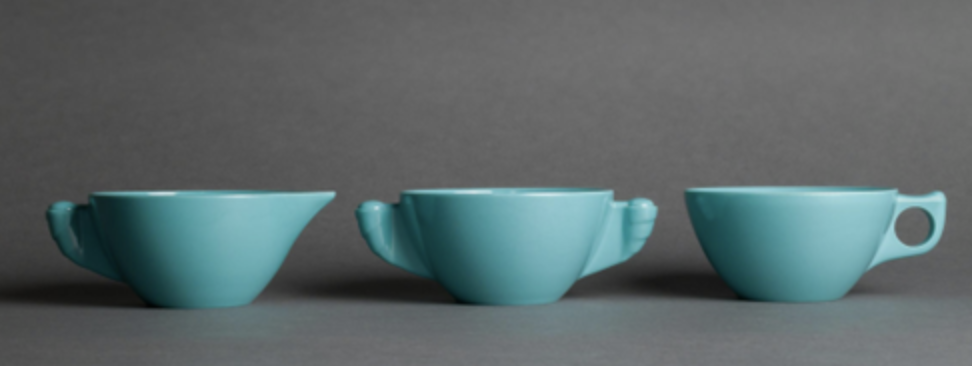
Tecoware Tea Service. Post 1945. Compression-moulded blue coloured melamine. Photo: Etienne Capacchione.
In the age of social media, our consumption of product photography is marked by the brevity of scroll culture. However the production of such images is wonderfully tedious. Archival and even e-comm photographs generally adhere to a standardized style much like the images I have produced for the xDX design objects housed at Carleton University. But product photographs also allude to narratives. For me, generating that narrative is an embodied way of learning about the materiality of design.
The process of photographing objects like the Tecoware tea service pictured above becomes an exercise in “slow looking.” So, while showcasing the formal design elements is crucial, selecting lighting that expresses the materiality of the object is equally important.
The texture of melamine is very smooth, but not as perfectly as glass or glazed pottery. Using a soft, diffused light helps to show how one smooth product feels compared to another. For most people, this is intuitive knowledge. Consider the comparison between the Tecoware and glazed ceramic below: the reflection of the light is diffused on the Melmac and nearly mirror-like on the glaze. A hard spotlight would be more difficult to differentiate.
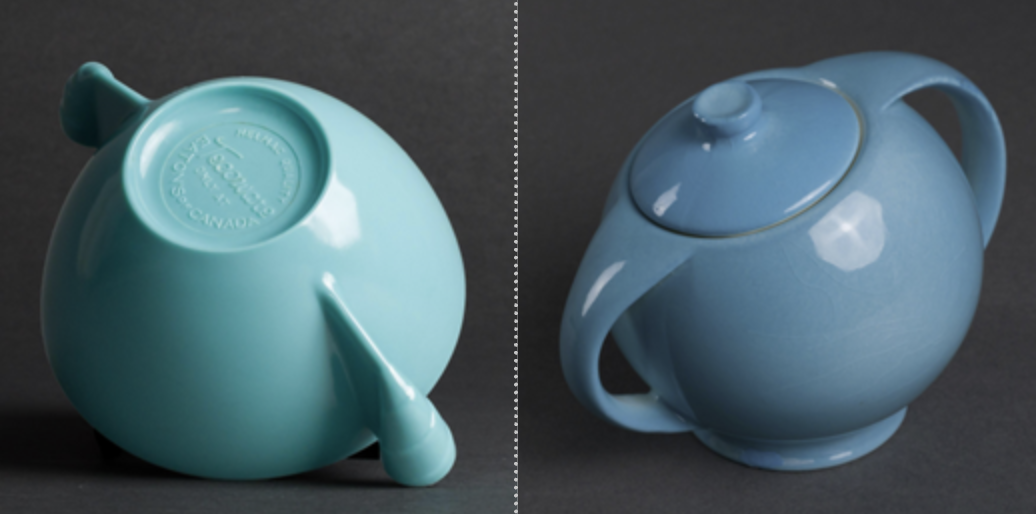
Tecoware Melmac Sugar Bowl. Post 1945. Compression-moulded blue coloured melamine (left). Medicine Hat Potteries Sugar Bowl. 1955-1938. Blue and white glazed ceramic (right). Photos: Etienne Capacchione.
This way of facilitating a narrative experience of the object (its use, its feel, etc.) is also my way of learning the specificity of the object. How does a material inform its use? Is it easier or more difficult to manipulate? Does it slip in the hand or support itself? It is easy to overlook these things when simply handling them as everyday objects. In short, to make a photograph, I need to ask: “What information is important?” and “How can I convey that in an image?”
Beyond an object’s function, the story that the image evokes is also telling the object’s status through highlighted product details. While this narrative approach is often limited in the context of archival work, it can be of great value. The image below of a glass ashtray is an example of a casualty of archival photography.
Glass presents specific challenges because it reflects, refracts, and is generally transparent and, in this case, is both curved and planar. To give each of the four indentations in the rim of the ashtray proper attention would have taken at least an extra 20 minutes in a dedicated product photography studio. Compared to a glass of beer which I shot over a full day as a photography student, the experience is decidedly different. The shape, materiality, use, and qualities of the glass are better represented than with the ashtray.
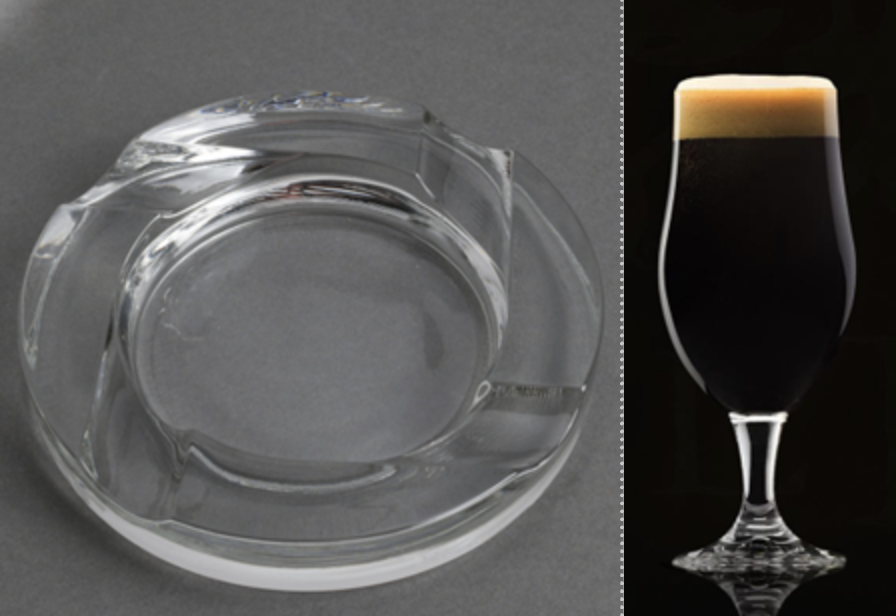
Ashtray. n.d. Glass/Crystal (left). Trois Mousquetaires Baltic Porter in Glass. November 25, 2017. Digital Photograph (right). Photos: Etienne Capacchione.
With this in mind, I would like to propose that researchers try the following activity as a method of “slow looking” to help understand both objects and the practice of photographic reading—a perfect exercise for a hands-on collection like xDX.
Take a useful object about the size of a mug and place it on a table in a darkened room. Use only your phone’s LED as a light source. Then, position yourself comfortably, face to face with the object. Without moving your head, slowly move the light from side to side, up and down, and back and forth. Pause when you find a satisfying angle.
Does something about the object’s shape or the quality of its material become more prominent? Perhaps you notice a small feature that had previously escaped your attention. Does chrome appear very dark compared to other materials? Are important features obscured by shadows? What potential uses or limitations of the object become apparent? Try adding a sheet of paper opposite the light and observe its effect.
Now repeat the exercise using a Google search page as the flashlight, very close to the object. You will have a comparatively “soft” light. Repeat the exercise. How does it differ? Does the object appeal more or less to you? Are any features more or less evident?
Now imagine something complex like an espresso machine. The lighting needs to highlight the shape and materiality of the object and its parts—the ergonomics of the portafilter, the shape of the group head, the functionality of the steam wand, the different buttons, any access feature for removing the drip tray, etc. Are the handles plastic or rubber? Are there indicator lights? Is the chrome brushed or polished? There are so many aspects that a single image (with support of a few close-ups) needs to portray. In the process of lighting the object, functional, design, and material elements will create all sorts of problems photographically, which draw attention to these features.
Given the ever-deepening financial struggles of researchers and archives, the increased reliance on digital assets for art and design collections can only benefit from this way of looking. The photograph both requires and fashions an understanding of the design object.
Etienne Capacchione, MA RA (photography), Carleton University

