Whenever I visit Montreal, I am struck by the city’s strong emphasis on art and design. Street art, public installations, galleries, handmade goods, curated vintage shops, and historic architecture all contribute to the city's artsy reputation. During my most recent visit, my travelling companion, an industrial design student, wondered if the city’s focus on art translated to its design culture, what studying as an industrial design student might be like in Montreal. In turn, I began to wonder whether an art-focused approach was also visible in Montreal-designed objects within the xDX collection. To find an answer, I turned to the xDX ResearchSpace. This research tool is still in its early stages. Using it to explore research questions helps those of us on the xDX team better understand its potential and limitations.
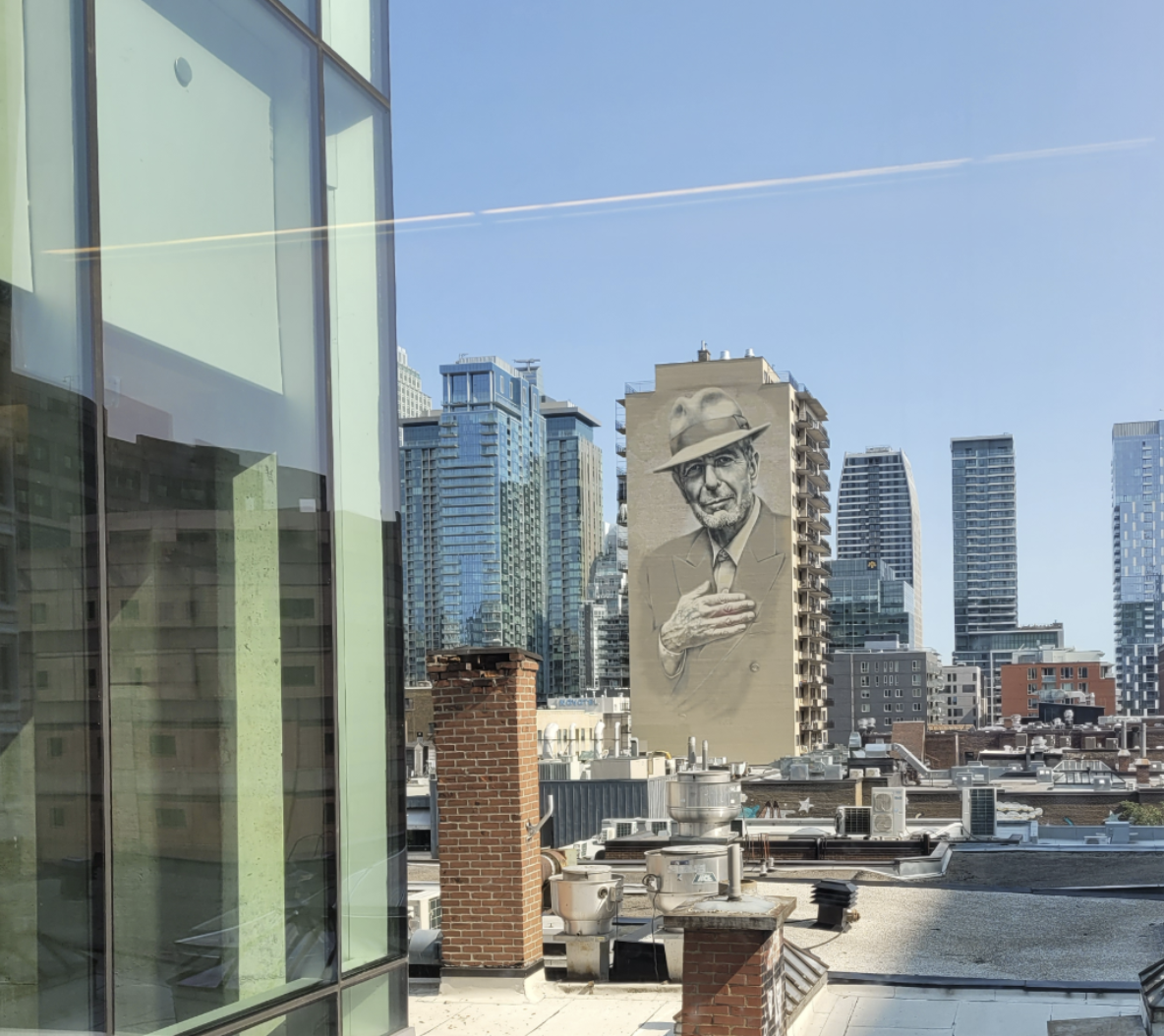
Figure 1. Mural of Leonard Cohen, as seen from La Musée des Beaux-Arts in Montreal. Photograph by Teresa Keuleman, 2025.
To explore post-war design in Montreal, I began by filtering the objects in the xDX ResearchSpace to include only objects designed in Montreal, and used this set to create a knowledge map, which can be accessed here. This immediately revealed a clear pattern: many of these objects shared a fine-arts sensibility. The majority of the objects were ceramics, with textiles also heavily represented. This discovery raised a further question: did post-war design education in Montreal encourage a fine-arts approach rather than a strictly industrial one?
Using the knowledge map, I identified the designers associated with these objects. A large number of the collection’s objects were designed in Montreal, so the initial state of the map was busy and difficult to read, especially after adding the designers. Fortunately, the “Auto Arrange” feature helped me quickly group related entities to make the map more legible. Identifying which designer was associated with which objects immediately became easier.
Using the knowledge map, I identified the designers associated with these objects. A large number of the collection’s objects were designed in Montreal, so the initial state of the map was busy and difficult to read, especially after adding the designers. Fortunately, the “Auto Arrange” feature helped me quickly group related entities to make the map more legible. Identifying which designer was associated with which objects immediately became easier.
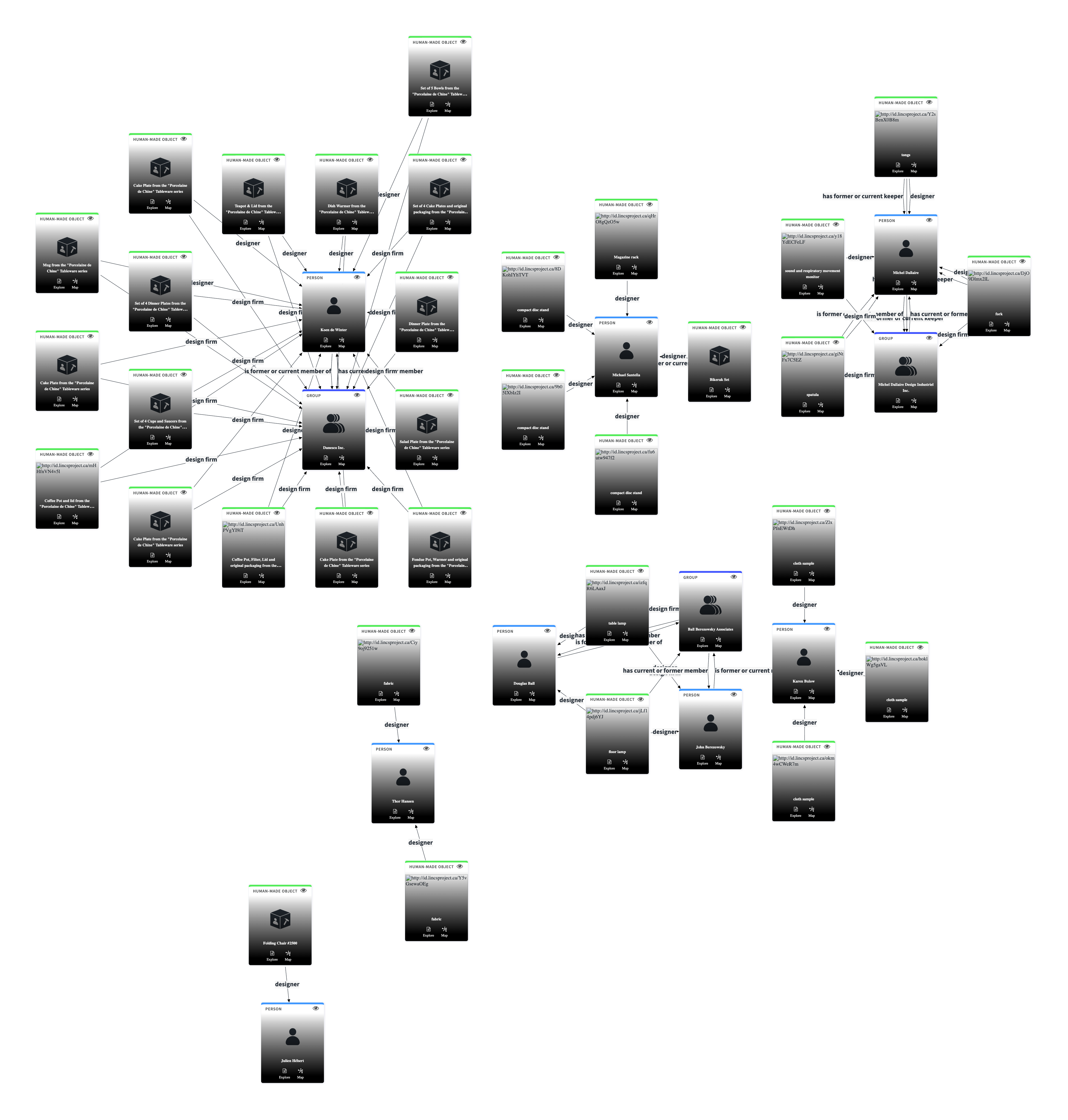
Figure 2. A Knowledge Map of Montreal designed objects and their respective designers.
Now that I had established designers who worked in Montreal in the post-war era, I could use this information as the starting point for exploring Montreal design education. Using the “Descriptive Note / Designer Note” feature of the various designers on ResearchSpace, I delved into their education and professional backgrounds. Through this research, I found that Julien Hébert was a prominent figure in Montreal design, having both studied and taught in the city. Specifically, Hébert studied at l’École des Beaux-Arts in Montreal.

Figure 3. Julien Hébert’s “Descriptive Note/Designer Note” feature in ResearchSpace.
Thanks to ResearchSpace, I now had a clear direction to continue my research. I began looking into l’Ecole des Beaux Arts pedagogical approach to design. I discovered that many professors at the school were trained in France and brought the French Beaux-Arts tradition with them.i This tradition, as the name suggests, focused on the fine-arts. And while not explicitly opposed to industrial production, this tradition did conflict with modern industrial design in a few ways.
Beaux-Arts pedagogy rejected many principles of Modernism and industrial design, including mass production, the elimination of ornamentation, and the distancing of designers from their work through industrial processes. Instead, it emphasized historical reference (particularly reference to classical Greek and Roman art) and required students to develop a broad range of artistic skills, from drawing and sculpture to conceptual design.1 This holistic, art-based approach contrasted sharply with the division of labor central to industrial design.
It is therefore unsurprising that some designers who trained at l’École des Beaux-Arts carried a fine-arts sensibility into their professional work. Hébert is no exception; however, he had also studied philosophy and was conscious of the social dimension of art in society. This led to an interest in design, which he saw as a utilitarian application of art.ii Eventually, Hébert began teaching at- l’École du Meuble, which was an offshoot of l’École des Beaux-Arts, created in 1935. Here, Hébert played a significant role as a professor and developed the design pedagogy of the school.iii He even taught Michel Dallaire, another designer whose work also appears in the xDX collection.iv
Ultimately, ResearchSpace served as an effective starting point for this investigation. Its knowledge mapping tool made it possible to identify trends, in this case a focus on the fine-arts, within Montreal design. Along with the descriptive notes on designers, this allowed me to trace connections between objects, designers, and educational institutions. Further research confirmed that Montreal’s post-war design education had a lasting impact on the city’s design culture; an influence that remains visible in Montreal’s vibrant streets, shops, cultural institutions and fashion identity today.
Teresa Keuleman, Undergraduate RA, Carleton University
Beaux-Arts pedagogy rejected many principles of Modernism and industrial design, including mass production, the elimination of ornamentation, and the distancing of designers from their work through industrial processes. Instead, it emphasized historical reference (particularly reference to classical Greek and Roman art) and required students to develop a broad range of artistic skills, from drawing and sculpture to conceptual design.1 This holistic, art-based approach contrasted sharply with the division of labor central to industrial design.
It is therefore unsurprising that some designers who trained at l’École des Beaux-Arts carried a fine-arts sensibility into their professional work. Hébert is no exception; however, he had also studied philosophy and was conscious of the social dimension of art in society. This led to an interest in design, which he saw as a utilitarian application of art.ii Eventually, Hébert began teaching at- l’École du Meuble, which was an offshoot of l’École des Beaux-Arts, created in 1935. Here, Hébert played a significant role as a professor and developed the design pedagogy of the school.iii He even taught Michel Dallaire, another designer whose work also appears in the xDX collection.iv
Ultimately, ResearchSpace served as an effective starting point for this investigation. Its knowledge mapping tool made it possible to identify trends, in this case a focus on the fine-arts, within Montreal design. Along with the descriptive notes on designers, this allowed me to trace connections between objects, designers, and educational institutions. Further research confirmed that Montreal’s post-war design education had a lasting impact on the city’s design culture; an influence that remains visible in Montreal’s vibrant streets, shops, cultural institutions and fashion identity today.
Teresa Keuleman, Undergraduate RA, Carleton University
Footnotes
[i] Emilie Girard, “Un Apprentissage Professionnel à l’école Des Beaux-Arts de Montréal,” Encyclopédie du MEM, November 30, 2022, https://ville.montreal.qc.ca/memoiresdesmontrealais/un-apprentissage-professionnel-lecole-des-beaux-arts-de-montreal?utm_source=chatgpt.com.
[1] Martin Racine and Alain Findeli, “Julien Hébert and the Emergence of Industrial Design in Canada,” Design Issues 19, no. 4 (October 2003): 32, https://doi.org/10.1162/074793603322545046.
[ii] Racine and Findeli, “Julien Hébert,” 34.
[iii] Racine and Findeli, “Julien Hébert,” 34.
[iv] Racine and Findeli, “Julien Hébert,” 34.

