I joined the xDX Project in the 2025-26 Winter term as a YorkU Public History placement student. At the time, the xDX team was proofing the final iteration of the xDX data and testing the xDX ResearchSpace tool in anticipation of it going ‘live’ at the beginning of Summer 2026. My fellow-placement student, Komal, and I spent our first weeks working with the team members sifting through hundreds of lines of data to ensure there were no errors or inconsistencies. Our next task was to research an artefact from the YorkU xDX Collection using xDX ResearchSpace. I selected Thomas Lamb’s Roo Chair as the object of my investigation and set out to learn more about one of his lesser-known design.
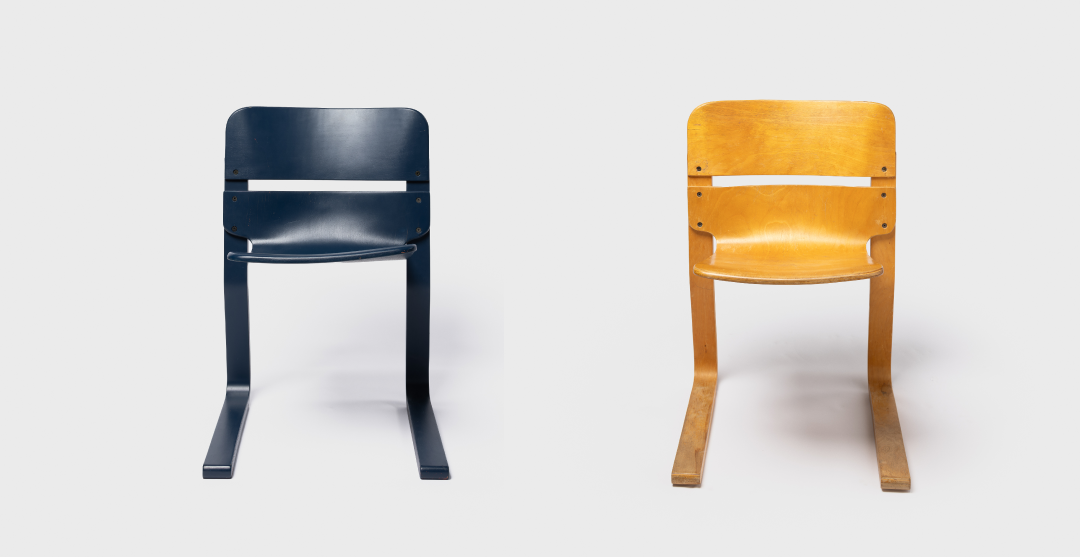
There were the two examples of the Roo Chair held in York’s xDX collection–one with natural varnish finish and another that had a blue painted finish. By using the xDX ResearchSpace Knowledge Map function, I was able to uncover additional connections between the chairs and to identify links to other objects held by xDX partner institutions. I discovered that there was yet another Roo Chair at an xDX partner institution, the Canadian Museum of History in Ottawa. The appearance of an additional chair in the Knowledge Map (depicted below) led me to my initial lines of questioning: how are these three chairs, with entirely different names, connected? Why are two of these chairs connected to Orono, Ontario, while the third links to Peterborough, Ontario? What exactly is this map trying to tell me?

Because Knowledge Maps visualize all the connections that exist between artefacts across the entire xDX dataset, it was possible to confirm all three chairs were examples of the same design, connected through a shared designer, material, and production history.Through discussions with the xDX team at York, it became clear that the differences in naming reflected institutional cataloguing practices rather than meaningful distinctions in chair design. Despite the variations, the “Roo Chair (blue paint),” the “Roo Chair in natural varnish,” and the chair identified as the “Roo Stacking Chair” shared the same overall design, were all made of plywood, and manufactured in 1970, making it most likely that they were three examples of a single model. The blue Roo Chair, however, was unusual, as there was no evidence of any coloured Roo Chairs being produced. The contextual notes in ResearchSpace indicated that Thomas Lamb may have painted the chair himself, to test the possibility of producing a line of coloured Roo chairs. A visit to the Clara Thomas Archives and Special Collections with Prof. Hadlaw to take a closer look at the blue Roo Chair confirmed that the blue paint had been applied on a varnished chair, and it was not likely to have been a factory-produced model.
The inconsistency in production locations on record was more difficult to explain. The data showed that both the ‘stacking’ and ‘natural varnish’ Roo Chairs were manufactured in Orono, Ontario by Plydesigns, a furniture division of Curvply, a manufacturer of moulded plywood products.1 The blue Roo Chair was also identified as produced by Plydesigns, however Peterborough was listed as the location of manufacture.2 This would suggest that production of the Roo Chair was distributed across different locations in Ontario.
Additional research, however, confirmed that both Curvply and Plydesigns operations were located in Orono, not in Peterborough. An article in the Orono Weekly Times announced the relocation of Toronto-based Curvply to Orono in 1958.3 Curvply established Plydesigns in 1970 in order to expand into the production of high-quality ply-furniture for domestic and export markets. Thomas Lamb was hired by Plydesigns in that same year to create a line of ply-furniture designs, one of which came to be known as the Roo Chair.4 Ultimately, it’s unclear why some sources identify the blue Roo Chair as being produced in Peterborough, although our research on the companies suggests that this may have been a data entry error.
My ResearchSpace investigation also revealed that the Archives of Ontario, an xDX partner, held the Thomas Lamb fonds, where information on the Roo Chair could be found. During a visit to the Archives with Professor Hadlaw to examine the archival records, I discovered product photos of the Roo Chair that were used in Plydesigns’ promotional materials, as well as magazine and newspaper clippings, technical drawings, and more.
Several magazine and newspaper articles on Thomas Lamb described him as one of this period’s leading designers. A 1986 Ontario Craft article identified Lamb’s moulded plywood designs as “sturdy, yet pretty and innovative.”5 The Steamer Chaise Lounge, perhaps Lamb’s most famous design, as well as the Roo Chair reflected his ongoing interest in experimenting with curved forms and the wider popularity of plywood furniture at that time.
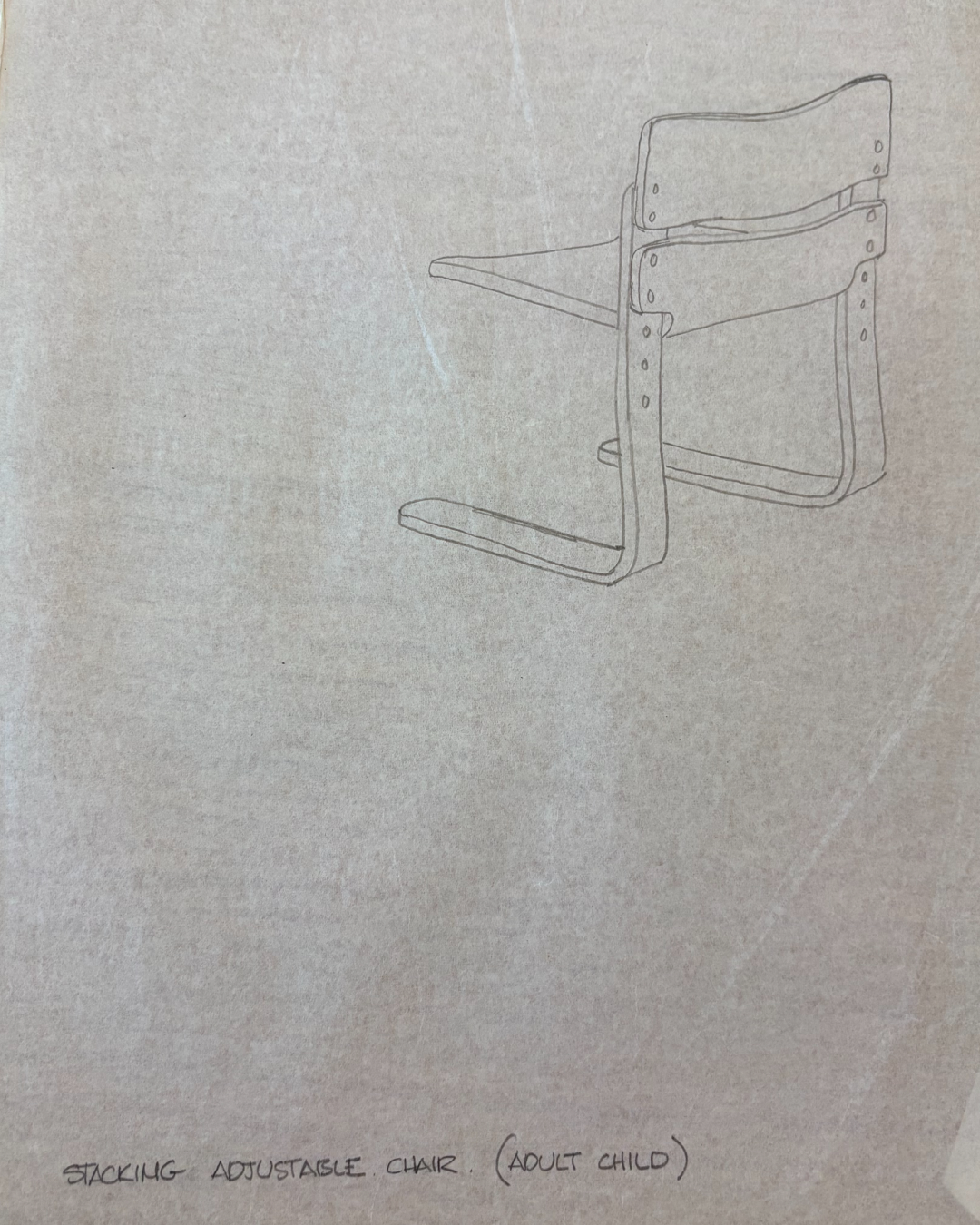
There were also several pencil sketches showing the Roo Chair from different angles, with some drawings indicating surface details such as wood grain patterns. While most of Lamb’s sketches were not individually dated, the Roo Chair drawings were grouped in files labelled 1969–1972. One drawing, titled “Stacking Adjustable Chair (Adult Child),” showed the backrest positioned at the rear of the seat, unlike the Roo Chairs in the xDX Collection, in which it is located in the front. Although the chair in the drawing is not identified as such, its overall form closely matches the curved legs, shaped seat and back of the Roo Chair, suggesting it represents an early version of the same design. Another sketch shows that Lamb explored moving the backrest forward to shorten the seat depth. This drawing closely resembles the actual artefact at the Clara Thomas Archives and Special Collections, indicating this idea was eventually used in the final design.
The Roo Chair is just one example of Thomas Lamb’s innovative chair designs. Although it garnered less acclaim than his Steamer series, it is an excellent example of Canadian postwar furniture design’s interest in material innovation and industrial production practices. The inconsistencies in the names and locations I discovered in ResearchSpace ultimately enriched my research experience. xDX ResearchSpace’s Knowledge Maps and hands-on engagement with the artefacts and archival materials in the xDX collection help me shape my research questions and pointed out the gaps needing to be filled in by consulting other historical sources. My Public History placement with the xDX Project not only helped me better understand the design and development of Thomas Lamb’s Roo Chair, it offered me a hands-on research experience using a wide range of research tools and resources.
Lok Ching Lee, Public History Placement Student, York University
Footnotes
1.) Rachel Gotlieb and Cora Golden, Design in Canada Since 1945: Fifty Years from Teakettles to Task Chairs (Toronto: Alfred A. Knopf Canada, 2001), 29.
2.) Curvply’s location is identified as Peterborough in both Design Exchange legacy data and Rachel Gotlieb and Cora Golden, Design in Canada Since 1945: Fifty Years from Teakettles to Task Chairs (Toronto: Alfred A. Knopf Canada, 2001), 26.
3.) “Curvply Wood Products to Move All Operations to Orono,” Orono Weekly Times, 10 April 1958, p. 1, Clarington Digital Newspaper Collection, https://vitacollections.ca/DurhamNewspapers/2923745/page/3
4.) “Award Winning Furniture Firm Tops in Curved Plywood” Orono Weekly Times, 10 July 1974, p. 4, Clarington Digital Newspaper Collection, https://vitacollections.ca/claringtonnews/2924535/page/6?q=curvply&docid=OOI.2924535
5) Thomas Lamb fonds, Publications – Thomas Lamb, F 4720-7, Box M B949882, Archives of Ontario, Toronto.

