
Figure 1: LINCS ResearchSpace Knowledge Map. Identifies artefacts created by Fred Moffatt in the xDX Collection held at York University.
To start my research, I made a knowledge map on LINCS xDX ResearchSpace. This map (figure 1) shows all the Moffatt kettles and related artefacts in the xDX collection held at YorkU. In the center of the map, in light blue, is what is referred to as the ‘entity’ for Fred Moffatt. Using his entity as my starting point, I was able to find the many kettle-related artefacts created by him. In the image of my Knowledge Map above, the row above Fred Moffatt’s entity are the kettles he designed. They are listed in order of their model number, which suggests approximately when each kettle was released. The row of entities below Fred Moffatt’s are other kettle-related artefacts he created, such as packaging materials and prototypes. The entity on the right is the K800 model number, which helped identify the objects that are part of the Auto II Boil ‘n Simmer series. The entities on the far left identify the manufacturing companies Fred Moffatt worked with, and the two rows at the very top indicate the location where the kettles were produced.
To get a better understanding of the kettles I was researching, I went to the Clara Thomas Archives and Special Collections, which holds the YorkU xDX artefacts. As this was my first time working directly with material artefacts, I found the experience very exciting. The kettles were much heavier than I expected and I was quite interested to learn that the kettles in this series were designed to be filled by water being poured through their spouts. I started my investigation by noting key differences between each kettle iteration. I noted that, the KE62 (figure 2) has a metal spout, while the KE840 and KE860 (Figures 3 + 4) have plastic spouts that are attached to the handles. Furthermore, unlike the KE840, the KE860 has a light indicator to tell you if the water is finished boiling.
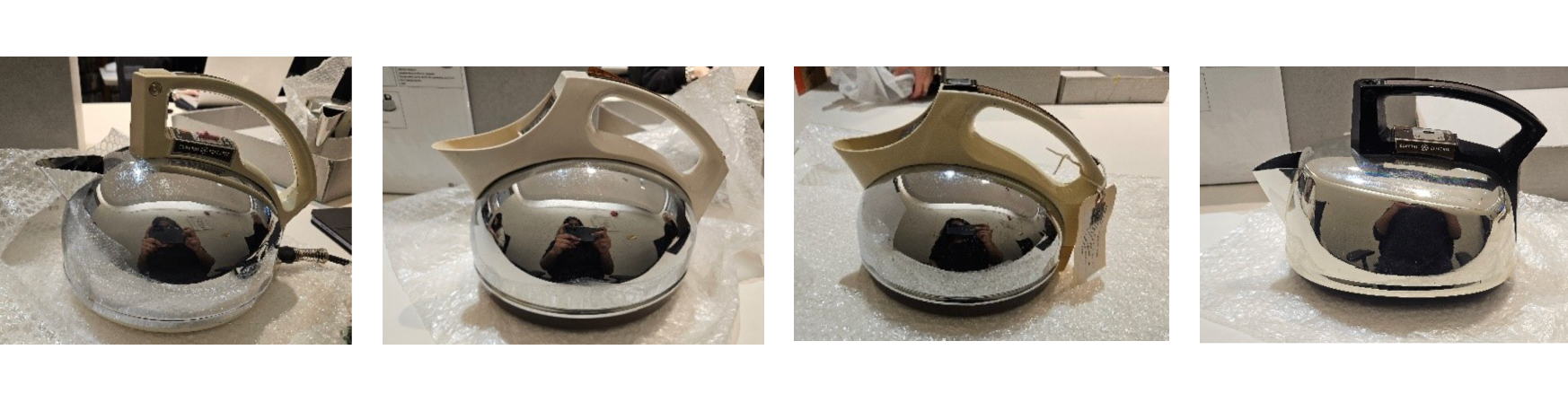
Left to right
Figure 2: KE62 Model
Figure 3: KE840 Model
Figure 4: KE860 Model
Figure 5: Kettle Protoype
As my research progressed, the knowledge map helped me locate records documenting the kettle’s design in the Fred and Glenn Moffatt Fonds, held at York University Libraries’ Clara Thomas Archives and Special Collections. The fonds include sketches, advertisements, and catalogue pages, as well as some examples of packaging that the Moffatts designed. In addition to the material I found in the fonds, Prof. Jan Hadlaw, PI of the xDX Project, shared material on Canadian kettle design that she had collected. Reviewing these resources, I discovered that Fred Moffatt's earliest kettle, the K42 model manufactured in the 1940’s, was quite a popular release, and received a lot of media attention1. Most of the articles, described this kettle as setting a new standard of design innovation2. While the media mainly focused on this kettle, most of Fred Moffatt’s other kettles, including the Auto Boil ‘n Simmer, also proved to be very popular with consumers. These elliptically shaped kettles appeared in many different store3s4and were manufactured for almost 20 years. One notable change that Fred Moffatt made to later kettles in this series was replace the circular dome shape of the kettle’s body with one that was elliptical shaped, a shape that was supposedly harder 5 copy. Notably, the design of the KE62 kettle retained the metal spout of the K42, although subsequent iterations in this series (KE480 and KE860) replaced the metal spouts with integrated spouts and handles made of plastic.
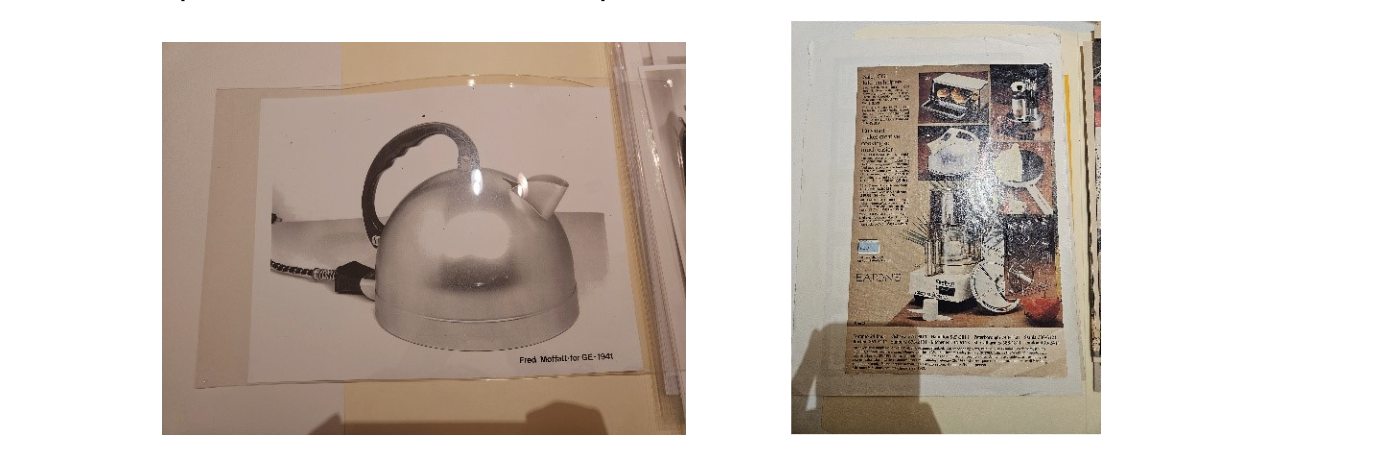
Left to right
Figure 6: K42 Model
Figure 7: Eatons catalogue
All the kettles Fred Moffatt designed were for Canadian General Electronics. Black & Decker’s acquisition of CGE in 1984 ultimately led to the end of Fred Moffatt’s kettle designing career6. Black & Decker, however, continued to manufacture the KE800 series after the takeover. Identified by model numbers KE801, KE861, and KE881, the kettles kept most features of the original and were advertised as “New” in their own catalogues, although the only design change I was able to identify was the addition of Black & Decker branding7.
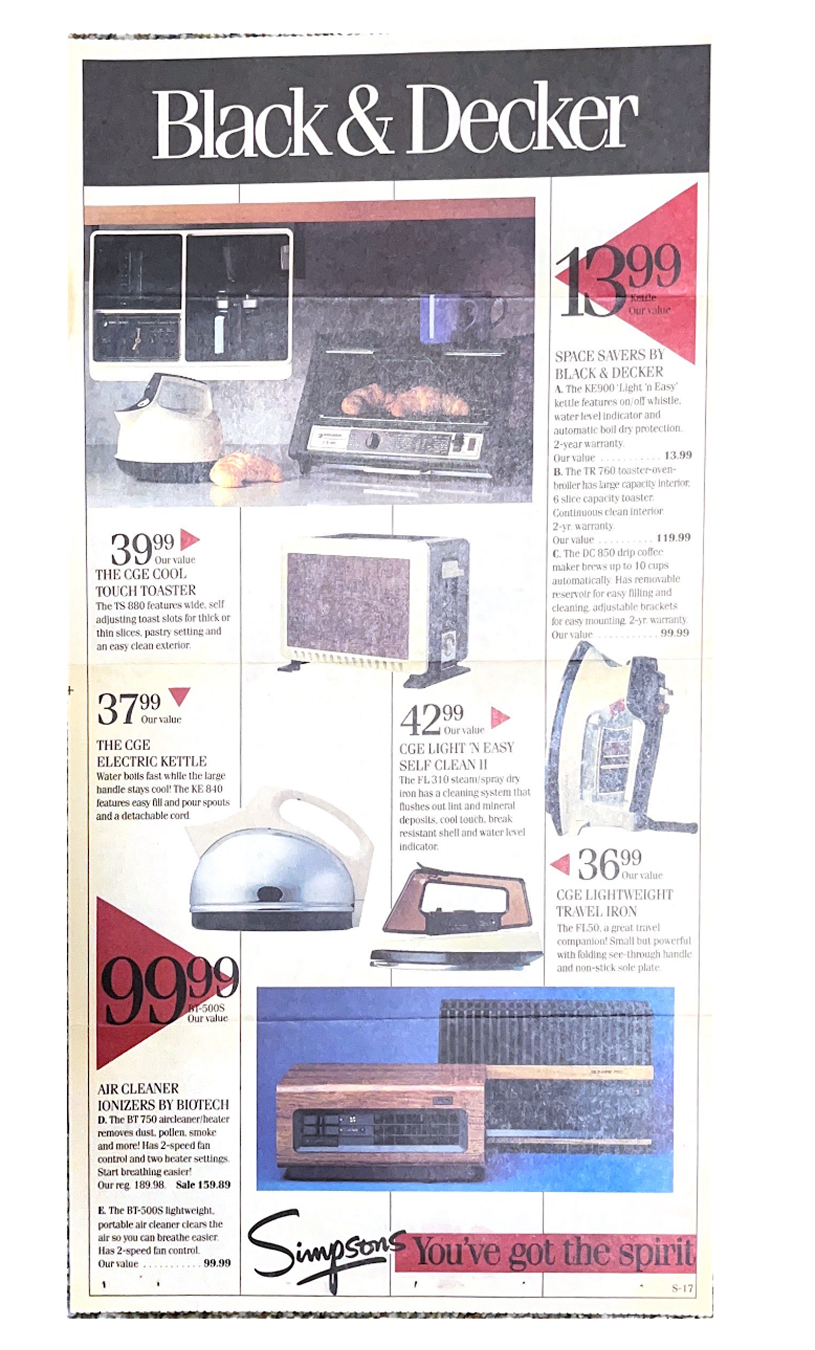
Figure 8: Black & Decker Catalogue
Studying the Auto Boil ‘n Simmer series designed by Fred Moffat allowed me to observe how each design iteration added features to improve the functionality, safety, and appeal of the kettle. Reviewing Moffatt’s original sketches revealed that this was not always a straightforward process8, often requiring consideration of many factors. As a student of ancient history, being able to work directly with modern designed artefacts was a wonderful experience. In this placement, I learned that studying the artefacts in xDX Collection reveals hidden stories in the history of Canadian Design. I’m interested to learn what others who take a similar journey discover by using the xDX ResearchSpace tool to explore the collection and discover their own findings.
Komal Patel, Public History Placement Student, York University
Footnotes
1. Favro, Terri. “The kettle, a cultural classic.” Toronto Star, 13 Apr. 2013, ProQuest, https://ezproxy.library.yorku.ca/login?url=https://www.proquest.com/newspapers/kettle-cultural-classic/docview/1327370950/se-2
2. “Canada by Design.” Toronto Star, 13 Dec. 2022, ProQuest, https://www.thestar.com/sponsored_sections/2022/12/12/canada-by-design.html?rf
3. Fred and Glenn Moffatt Fonds. Moffatt Fonds 2024-006/009 (64). Clara Thomas Archives and Special Collections, York University Libraries, Toronto, Ontario.
4. Dunphy, Catherine. “Designer made mark with kettle.” Toronto Star, 21 Sept. 2006, ProQuest, [pdf].
5. Jannuska, Jennifer. “Canadian Designs: The Moffatt K42 Electric Kettle.” Deeth Williams Wall, 8 Dec. 2022, https://www.dww.com/articles/canadian-designs-moffatt-k42-electric-kettle
6. Steed, Judy. “'Kettle men' created Canadian icons.” Toronto Star, 1 Apr. 2002, ProQuest, [pdf].
7. Fred and Glenn Moffatt Fonds. Moffatt Fonds 2024-006/010 (29). Clara Thomas Archives and Special Collections, York University Libraries, Toronto, Ontario.
8. Fred and Glenn Moffatt Fonds. Moffatt Fonds 2024-006/005 (04). Clara Thomas Archives and Special Collections, York University Libraries, Toronto, Ontario.

